 Kuvo
KuvoThe app
Find your way around Kuvo's window, menu bar and settings.
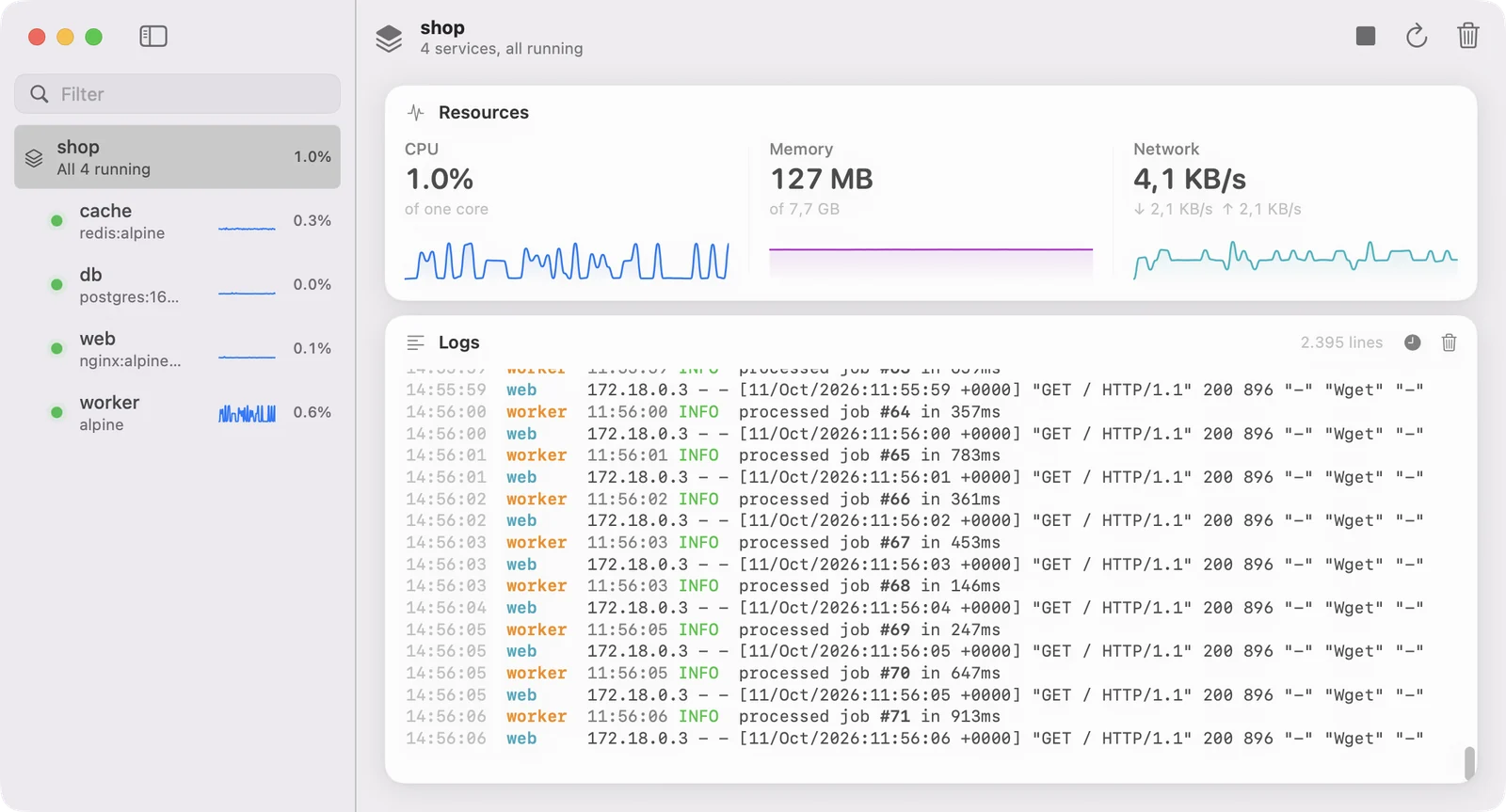
Kuvo’s window has two parts: a sidebar with every container, and a detail view for whatever you select. Everything updates on its own as containers start, stop and change, whether you used the app, the docker command or the kuvo command.
The sidebar
Each container has a row with a status dot, its name, its image and up to two published ports. Running containers also show a small CPU graph and their current CPU use.
- Hover a row to reveal a start or stop button.
- Right-click a row for everything else: restart, pause, open a terminal, open a published port in your browser, copy the ID or name, archive, or remove.
- Filter with the field at the top. It matches names and images. Press Esc to clear it.
The status dot is green with a soft pulse while a container runs, yellow when it’s paused, orange while it’s starting, stopping or restarting, blue if it was created but never started, and gray when it’s stopped.
Compose projects
Containers started by Docker Compose are grouped under their project. The project row shows how many services are running and their combined CPU.
- Hover the project’s icon to turn it into a chevron, then click to collapse or expand the group. Filtering always expands groups so matches are never hidden.
- Select the project to see its combined resources and its services’ logs merged into one stream, each line labeled with its service in its own color.
- Start, stop, restart or remove the whole project from the toolbar or by right-clicking the project row.
When you remove a project, Kuvo asks whether to keep its volumes. Remove deletes the containers and keeps the data in their volumes. Remove with Volumes also deletes the volumes the containers mount and the project’s named volumes. Volumes still used by other containers are always kept.
Container details
Select a container to see:
- The title bar: its name, how long it’s been running (and its health check status, if it has one), its image, and who created it if it was made with
kuvo new. - The toolbar: a button for each published port that opens it in your browser, a terminal, start or stop, restart, archive, and remove.
- Resources and Logs, described below.
Resources
The Resources pane shows CPU, memory and network use, updated every second, with a minute of history.
- CPU is a percentage of one core, so a container using two full cores shows 200%.
- Memory is the container’s current use, out of the memory available to the VM.
- Network is total traffic, with received and sent shown separately below it.
Live stats only stream while the window is on screen. When you close, minimize or cover the window, Kuvo stops collecting them, which is a large part of why it uses so little power when you’re not looking at it.
Logs
The Logs pane follows the container’s output as it’s written, with the colors the program printed.
- The wrap button (a return arrow) wraps long lines to fit the pane. It’s off by default, so long lines run past the edge and you scroll sideways to read them.
- The clock button shows or hides the time each line arrived.
- The trash button clears the view. It doesn’t delete anything from the container.
The wrap and clock buttons are tinted while they’re on, and Kuvo remembers both settings.
For a Compose project, logs from every service are merged in time order, each labeled with its service.
Terminal
Press ⌃ ` (or click the terminal button in the toolbar) to open a shell in the selected container, in a pane next to its resources and logs.
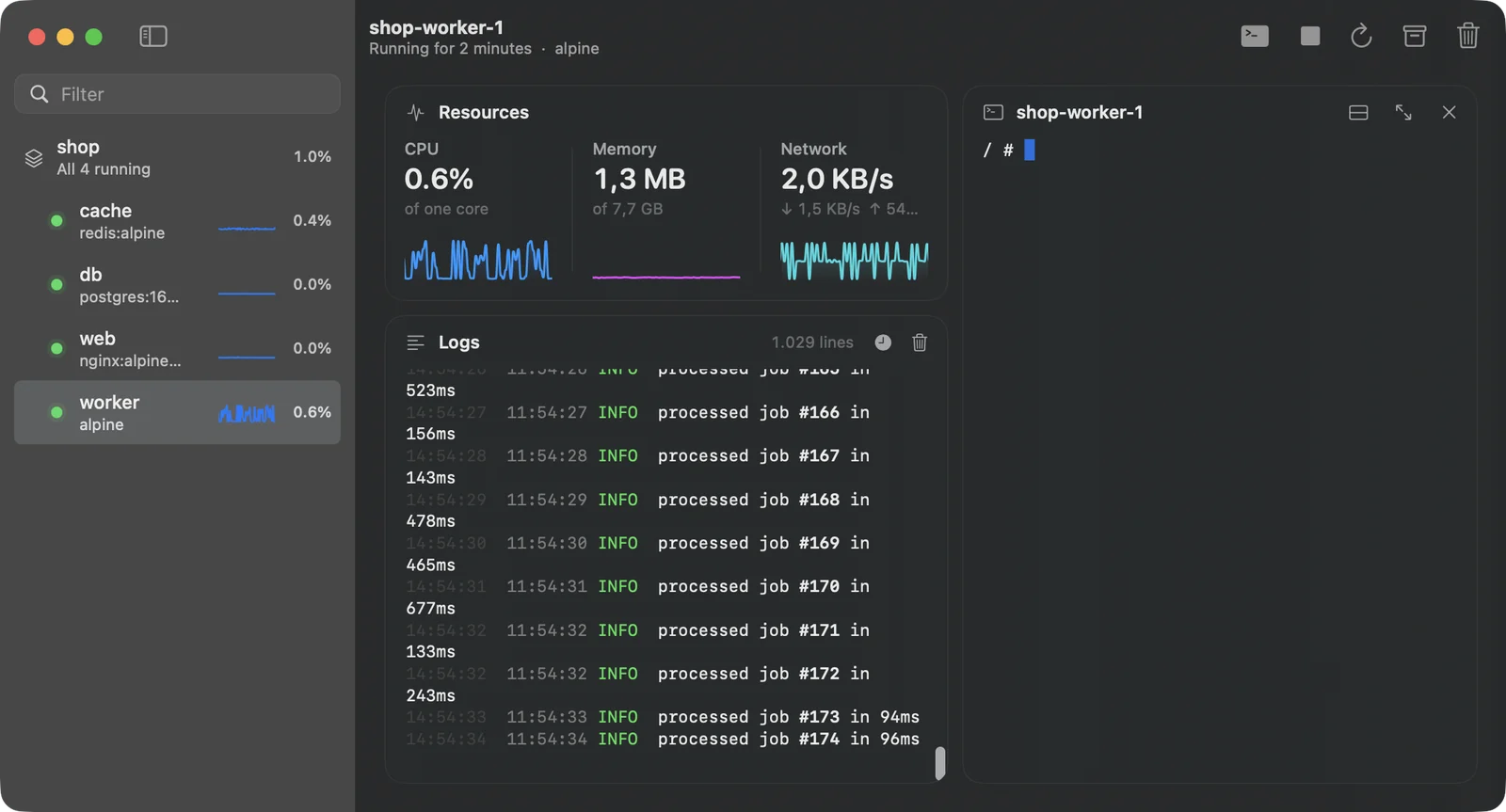
The shell is bash if the image has it, otherwise sh. Each container keeps its own terminal while you switch between containers. From the pane’s header you can move it below the other panes, maximize it, or close it.
To use your own terminal app instead, right-click the container and choose Open in Terminal App, or run kuvo shell <container>.
Archive
Archiving stops a container and keeps it for a while instead of deleting it right away. Archived containers show an archive icon and when they’ll be deleted. Restore starts one again.
You choose how long archived containers are kept in Settings. Nothing else is ever deleted automatically.
Menu bar
Kuvo has a menu bar icon that lists every container with a start or stop button, so you can manage them with the window closed. Closing the window doesn’t stop Kuvo or your containers. Quitting Kuvo does: it shuts down the VM cleanly, which stops every container.
Settings
Open Kuvo › Settings (⌘ ,).
| Setting | What it does |
|---|---|
| Appearance | System, Light or Dark. In light mode the window’s glass adapts to how bright your wallpaper is. |
| Delete archived containers after | 1 day, 7 days (the default), 30 days, or Never. |
Kuvo › About Kuvo shows the app version and the Docker version running in the VM.
Keyboard shortcuts
| Shortcut | Action |
|---|---|
| ⌃ ` | Open or close the terminal for the selected container |
| ⌘ . | Stop the selected container |
| ⌘ R | Start the selected container |
| ⌘ , | Settings |
| Esc | Clear the sidebar filter |